
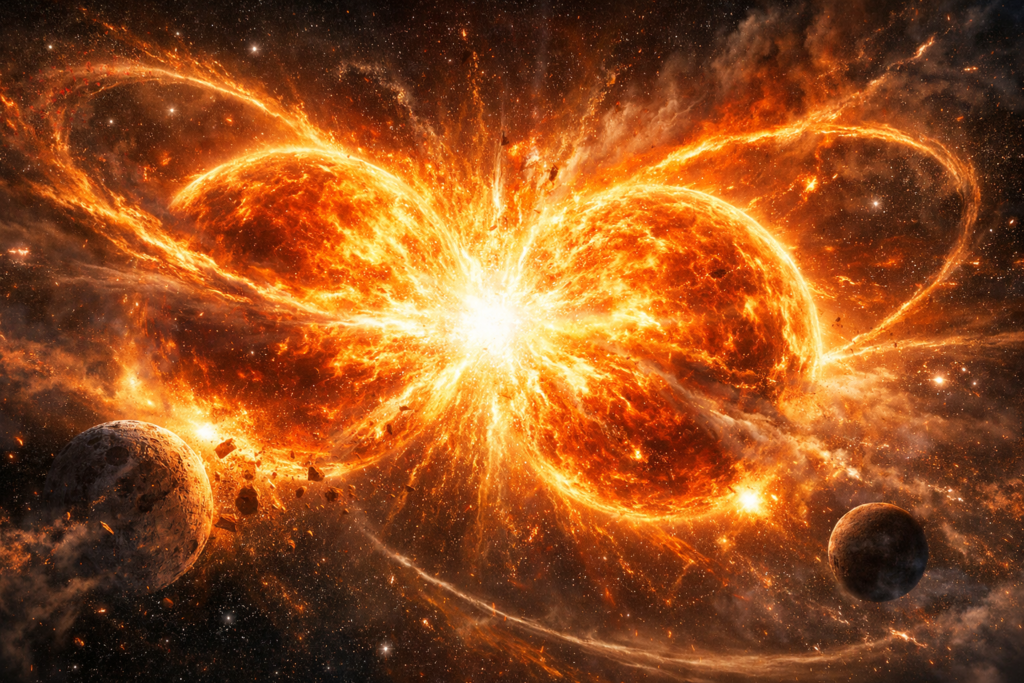
What if we launched a Sun into another Sun? It sounds like the ultimate cosmic crash — but stars don’t behave like solid objects. A stellar collision would unleash terrifying gravity-driven chaos, intense radiation, and a brand-new, more powerful star.
🧲 Phase 1: Gravity Turns the Crash Into a Cosmic Trap
Long before contact, the two stars begin to pull, stretch, and distort each other. Their outer layers (hot plasma) interact first, triggering violent tidal forces and extreme magnetic turbulence.
- 🌪️ Massive tidal deformation begins
- ⚡ Magnetic fields tangle and amplify
- 🔥 Supercharged stellar storms erupt
- 🌫️ Outer plasma envelopes start mixing
🌞🌞 Phase 2: The “Impact” Is Not a Solid Collision
Stars are mostly plasma, not rock. When they collide, their material doesn’t shatter like a planet. Instead, the stars slam, compress, stream through, and violently merge as shockwaves race outward.
- 💥 Enormous shock fronts ripple through both stars
- 🌊 Plasma surges outward in giant arcs
- ✨ A blinding burst of light and heat expands into space
🚫 Would It Cause a Supernova?
No — not if both stars are Sun-like. A classic supernova typically requires a much more massive star reaching the end of its life. Two Sun-mass stars colliding is still catastrophic, but it usually results in a stellar merger, not an immediate supernova.
- ✅ Likely outcome: one larger merged star
- ❌ Unlikely outcome (for Sun-like stars): instant supernova
🌟 The Aftermath: A Bigger, Brighter Star Is Born
After the chaos settles, the two Suns become one heavier star. More mass means stronger gravity, higher core pressure, and faster fusion.
- 🌞 Brighter and hotter than either original star
- ⏳ Burns fuel faster (shorter lifespan)
- 🧪 More turbulent and unstable at first
In simple terms: the collision doesn’t “turn the lights off.” It creates a more intense star that spends its energy faster.
🪐 What Happens to Planets and Orbits?
If either star had planets, most of them would face one of three fates:
- 🔥 Evaporated by sudden heat and radiation
- 🌀 Thrown into chaos by gravitational disruption
- 🚀 Ejected into interstellar space as rogue planets
Any habitable zone would be erased instantly — a Sun-Sun collision is an extinction event on a solar-system scale.
🧠 Final Take
When two Suns collide, they don’t simply explode and vanish. Gravity usually forces a merger, creating a single, more massive, more luminous star. The real destruction happens to everything nearby — planets, orbits, and any chance of life.
In the universe, the most terrifying weapon isn’t fire — it’s gravity.
🔎 Keep Exploring
If you enjoyed this cosmic scenario, you’ll love this next one:
👉 ⏱️ What If Time in the Universe Moved 1 Million Times Faster?