
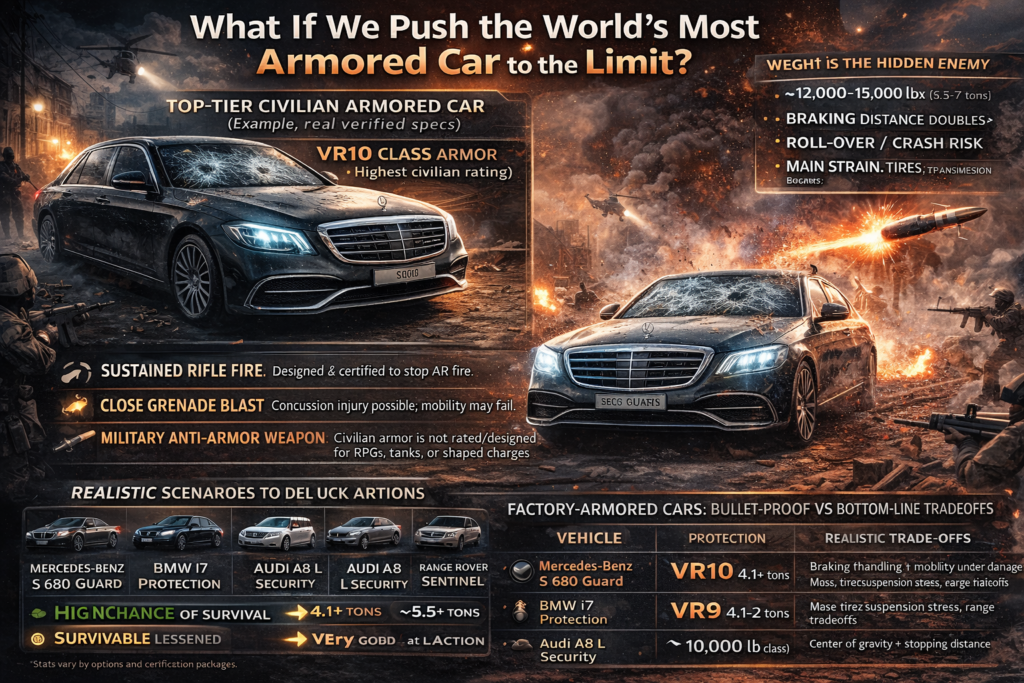
What If We Stress-Test the World’s Most Armored Car? (Real Limits, Real Physics)
🚙💥 WHAT IF / Realistic Stress Test
Imagine the toughest factory-armored limousine money can buy—thick ballistic glass, reinforced capsule, run-flat tires— then we push it past the marketing and into reality. Not “movie logic”… physics logic.
VR10 / VR9 ballistic ratingsblast & bullet survivabilityweight = hidden weaknessshort, comment-friendly
🧠 Quick Context: What “Top Civilian Armor” Really Means
The highest mainstream civilian standards use VPAM ratings (VR levels). In simple terms: VR8–VR10 vehicles are built to resist rifle threats, armor-piercing rounds (at the top end), and certain blast scenarios—while still being drivable on public roads.
Reality check: even the best armored car is designed to buy time, not “win a war.” Military anti-armor weapons are a different category entirely.
🔍 The Stress Test (Realistic Scenarios)
🔫 Scenario 1: sustained assault-rifle fire (multiple impacts, short range)High survival chance
Against typical rifle threats, a true VR9/VR10 capsule can stop penetration. The “loss condition” is often visibility (glass becomes crazed), mobility (tires/suspension), or getting boxed in.
💣 Scenario 2: close-by blast (roadside-style shock + fragments)Survivable, but vehicle may fail
The passenger cell can remain intact, but blast shock can disable electronics, suspension, and steering. In real escapes, the goal becomes: move 30–60 seconds longer than the threat.
🔥 Scenario 3: heat + smoke + “stuck in traffic” (the underrated killer)Depends on time
Armor adds mass and reduces ventilation. In a long standstill, heat, smoke infiltration, and panic can become bigger threats than bullets. “Armored” doesn’t mean “comfortable under siege.”
🚀 Scenario 4: military anti-armor weapons (shaped charges)Very low survival chance
Civilian armor is not built like a tank. Once you cross into dedicated anti-armor weapons, the physics and design goals change completely. The most realistic outcome is: armor buys seconds, not victory.
⚖️ The Hidden Weakness: Weight (Physics Always Collects Its Debt)
- 🛑 Longer braking distances: tons of extra mass = more stopping distance, more heat in brakes.
- 🌀 Handling risk: sudden maneuvers increase rollover and loss-of-control risk.
- 🔧 Mechanical strain: tires, suspension, and drivetrain become frequent failure points.
In many real high-risk incidents, the “final boss” is not gunfire—it’s a crash.
📊 Quick Comparison Table (Factory Armored Icons)
Approx specs vary by configuration; this table focuses on the common headline protections and the core tradeoff: protection vs weight.
| Vehicle | Typical Protection (VPAM) | Approx Weight | Built For | Most Realistic Weak Point |
|---|---|---|---|---|
| 🚘 Mercedes-Benz S 680 Guard | VR10 (top civilian level) | ~4.2+ tons | Maximum discreet VIP protection | Braking/handling + mobility under damage |
| ⚡ BMW i7 Protection | VR9 (high-level civilian protection) | ~4.3–4.9 tons | High protection with modern tech | Mass, tire/suspension stress, range tradeoffs |
| 🛡️ Audi A8 L Security | VR9 (with advanced safety systems) | ~3.9 tons | Executive protection + emergency systems | Mobility after blast (electronics/suspension) |
| 🛰️ Range Rover Sentinel | VR8 (serious rifle-level protection) | ~10,000 lb class (~4.5 tons) | Off-road capable high-security SUV | Center of gravity + stopping distance |
🧩 Final Take (Comment Bait, But True)
The “most armored car” is incredible against civilian-grade threats and short ambush windows— but it’s still a car. If you push it to the edge, the real limits aren’t Hollywood explosions… it’s weight, mobility, visibility, and time.
💬 Debate starter: Would you rather have VR10 protection but worse handling, or slightly less armor with better escape speed?
🔗 Keep Exploring on WhatIfHub
If you liked this “reality vs hype” scenario, try this next:
👉 😴 What If No One Could Sleep? A Day-by-Day Collapse of the Human Mind
Note: This is an educational “what if” based on publicly described protection standards (VPAM/VR levels) and common engineering tradeoffs. Exact specs vary by build, options, and certification packages.