
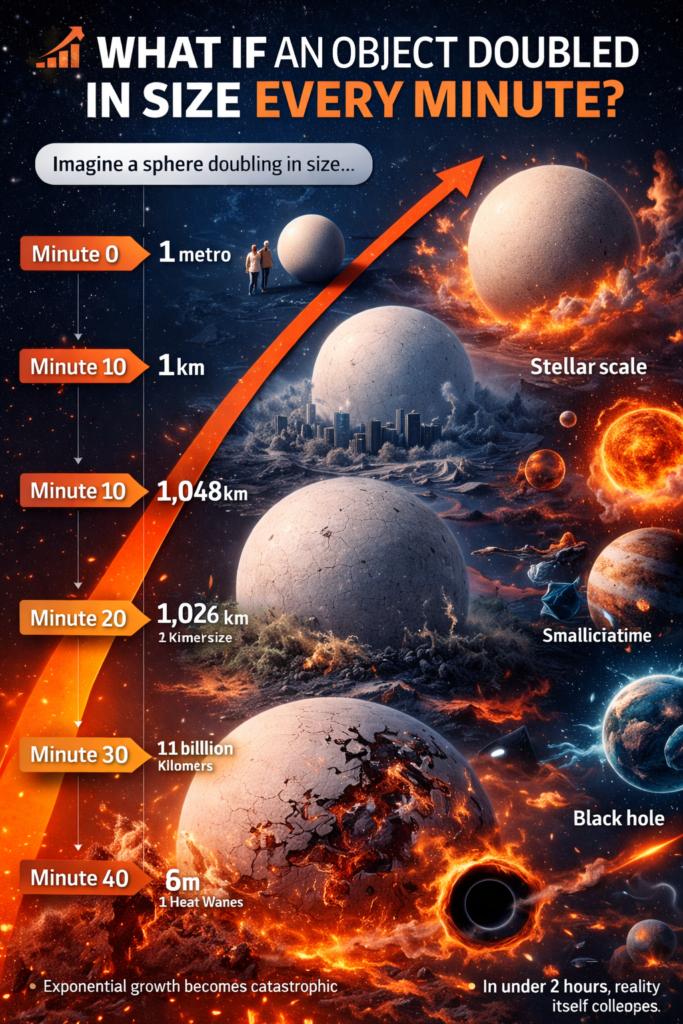
Imagine a simple object.
A sphere with a diameter of just 1 meter, placed on Earth.
It doesn’t explode.
It doesn’t move.
It doesn’t emit energy.
👉 It follows only one rule:
Every single minute, its size doubles.
What follows is a terrifying lesson in exponential growth.
⏱️ Minute 0 — The Beginning
- 📏 Diameter: 1 meter
- 📍 Comparable to: a large exercise ball
Nothing unusual. You could stand next to it without concern.
⏱️ Minute 1
- 📏 Diameter: 2 meters
- 📍 Comparable to: a doorway
Still harmless. People are curious, not afraid.
⏱️ Minute 2
- 📏 Diameter: 4 meters
- 📍 Comparable to: a large car
The growth is noticeable, but danger feels distant.
⏱️ Minute 5
- 📏 Diameter: 32 meters
- 📍 Comparable to: a 10-story building
The ground cracks. Nearby structures collapse under pressure.
⏱️ Minute 10
- 📏 Diameter: 1,024 meters (1.02 km)
- 📍 Comparable to: a massive skyscraper
Entire city blocks are crushed simply by expansion.
⏱️ Minute 12
- 📏 Diameter: 4,096 meters (4 km)
- 📍 Comparable to: a small city
Air is violently displaced. Extreme winds form around the object.
⏱️ Minute 15
- 📏 Diameter: 32,768 meters (32.7 km)
- 📍 Comparable to: a large metropolitan area
The object’s mass begins generating its own gravity. Buildings and terrain are pulled inward.
⏱️ Minute 18
- 📏 Diameter: 262,144 meters (262 km)
- 📍 Comparable to: the distance between major cities
Oceans nearby begin to rise. The atmosphere destabilizes.
⏱️ Minute 20
- 📏 Diameter: 1,048,576 meters (1,048 km)
- 📍 Comparable to: small countries
Tsunamis, earthquakes, and global climate disruption begin.
⏱️ Minute 22
- 📏 Diameter: 4,194 km
- 📍 Comparable to: half a continent
Earth’s curvature deforms. Satellites lose stable orbit.
⏱️ Minute 25
- 📏 Diameter: 33,554 km
- 📍 Comparable to: 2.6× Earth’s diameter
Earth’s gravity is no longer dominant. The Moon begins to drift.
⏱️ Minute 28
- 📏 Diameter: 268,435 km
- 📍 Comparable to: 70% of the Earth–Moon distance
Oceans lift into massive walls. Earth’s rotation slows.
⏱️ Minute 30
- 📏 Diameter: 1,073,741 km
- 📍 Comparable to: 3× the Earth–Moon distance
Earth is torn apart. The planet ceases to exist.
⏱️ Minute 33
- 📏 Diameter: 8.5 million km
- 📍 Comparable to: 6× the Sun’s diameter
The object dominates the inner solar system.
⏱️ Minute 35
- 📏 Diameter: 34 million km
- 📍 Comparable to: Mercury’s orbit
Planets drift. Asteroids fall inward like dust.
⏱️ Minute 38
- 📏 Diameter: 275 million km
- 📍 Comparable to: Venus’s orbit
The Sun begins losing stability.
⏱️ Minute 40
- 📏 Diameter: 1.099 billion km
- 📍 Comparable to: Earth’s orbit
The solar system is no longer recognizable.
⏱️ Minute 45
- 📏 Diameter: 35 billion km
- 📍 Comparable to: multiple planetary orbits
Internal pressure becomes extreme. Physics begins to fail.
⏱️ Minute 50
- 🌞 Stellar scale
- 🔥 Temperatures reach millions of degrees
Nuclear fusion may begin. The object behaves like a star — or worse.
⏱️ Minute 55
- 🕳️ Gravitational collapse
- ⏳ Time distortion begins
The critical limit is crossed. A black hole is born.
⏱️ Minute 60
- 🌌 The solar system is consumed
- 🧲 Nothing escapes
Planets, stars, and light vanish.
⏱️ Minute 70–90
- 🌠 Nearby star systems collapse
- 🌌 The Milky Way deforms
- ♾️ Physics breaks down
Reality itself becomes unstable.
🧠 Final Conclusion
An object that truly doubles in size every minute doesn’t need violence.
Mathematics alone destroys planets, stars, and galaxies.
In less than two hours, the universe cannot survive its existence.
📈 Exponential growth is the most dangerous force imaginable.